What We Learned From Our First Cohort
Raymond Jestone
July 12, 2026 · 7 min read
We believe in telling our story honestly, including the parts that don't flatter us. So here are the real numbers from our very first training.
Twenty people signed up. Three finished.
The setup
Our first hosted trainings were in web development and programming. We wanted them within reach of anyone, so we made them almost free: a small commitment fee of 5,000 shillings, and that was it. Twenty people signed up, and we were genuinely excited. Twenty future builders, we thought.
Then the training started, and reality did what reality does. Some quit in the first week. More left in the second. Others made it to the third before disappearing. By the end, three people out of twenty had gone the distance and completed the training.
Three out of twenty. You don't forget a number like that.
What the seventeen taught us
It would be easy, and wrong, to say the seventeen who left just didn't want it enough. The truth is more interesting, and it starts with who they were.
Most of them were finalists, and by the time the training began, they had just finished their final semester and were back home. We ran the sessions online at 8:00 PM to accommodate them, but it wasn't enough. Home, it turns out, is a different country. There were responsibilities to handle, family matters to deal with, and by evening most were simply too tired. And for many, especially the men, there was a heavier weight: the pressure to find a job and start earning, right now. When your family is watching and your pockets are empty, a weeks-long programming course with no immediate payoff feels like a luxury you can't defend. One by one, it stopped happening for them.
We hold nothing against a single one of them. They weren't weak; their window had closed. The time in life when you can sit with a hard skill for weeks, fail at it, and keep going, with no one demanding money from your efforts yet, is exactly the time they had just run out of.
There was a second lesson underneath: signing up is not commitment. A 5,000 shilling fee was low enough that walking away cost almost nothing, and when quitting is nearly free, quitting is what happens the moment things get hard. Learning to program does get hard, usually around week two, which is exactly when our room started emptying. We've carried that into everything since, including why membership at Collably asks for real commitment. But even commitment has a season, and that was the louder lesson: access was never the scarce resource. Time, freedom, and commitment are, and school is the last place all three exist together.
What the three taught us
Now here's the detail that turned this from a disappointment into a discovery.
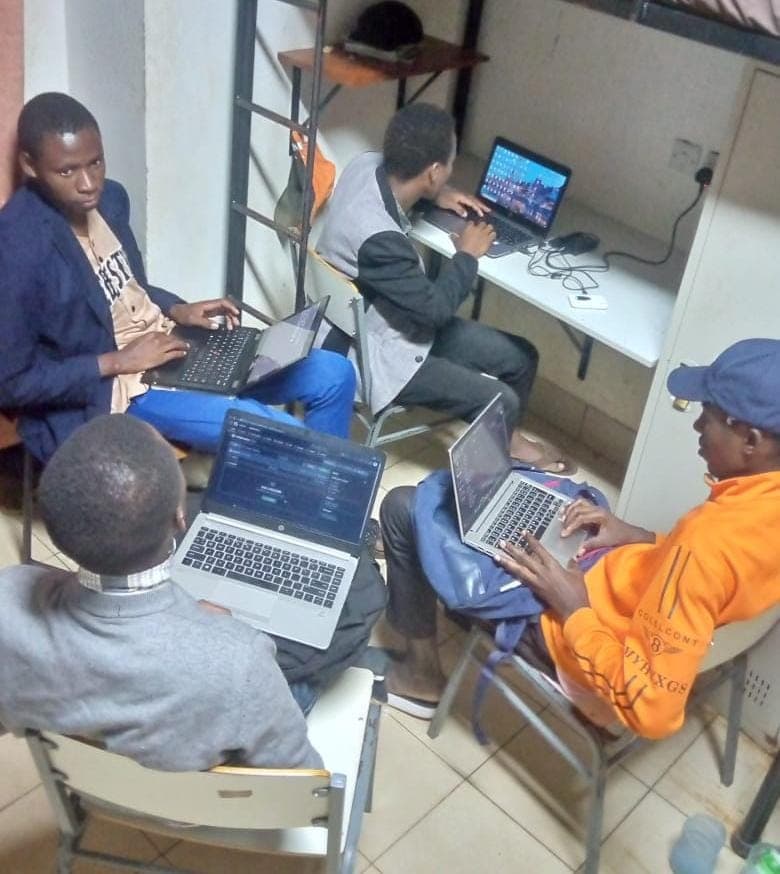
The three who finished had something in common, and it wasn't talent. Every single one was a continuing student, first-years at the time. Not one finalist finished. The three were still in school, they happened to be in one place, and they were close to the instructors. Their days had room for the hard weeks. Nobody was demanding money from their efforts yet. When they got stuck, help was within reach.
Look at that pattern honestly and it says something we had been claiming since the beginning: school is the best place to try, learn, and fail. We had believed it as an argument. The first cohort handed it to us as evidence. The same training, the same price, the same instructors, and the outcome split almost perfectly along one line: those still inside the window finished, and those whose window had just closed could not.
The problem to solve was never the training itself. It was reaching people while they're still in the season of life where finishing is possible. That reframing changed how we think about everything: less "how do we get more signups" and more "how do we reach builders early, while time is still on their side."
Then we went quiet, on purpose
After that first cohort, we didn't run another training for nearly a year. From outside, it may have looked like Collably had joined the graveyard of youth programs that launch loudly and vanish quietly.
Inside, it was the opposite. That entire time, Collably was being rebuilt from the foundation up.
At the time of that first training, Collably was one person: the founder, doing everything. That's not an organization; it's a stretched individual, and stretched individuals break. So the year went into the unglamorous work. Sigfrid Mario joined to push the mission, and Collably started taking a new shape. Stanslaus Kitandala came on board after. Together we made the decision to make this permanent: registering Collably as an NGO, putting real structure behind it. Mario now serves as our Chief Operations Officer and Kitandala as our Chief Finance and Administration Officer. We built the platform, the legal foundation, and the team that a long promise actually requires.
It was the least visible year of Collably's life, and the most important one. We had learned from our own membership philosophy: we would rather go quiet and build something durable than stay loud and stay fragile.
Round two
Now the foundation is in place, and trainings are coming back.
They come back designed by everything the first cohort taught us: real commitment asked upfront, cohorts kept small enough that nobody can quietly disappear, and a focus on reaching students while they're still students, while the window is wide open, because that's when finishing is possible and failing is affordable.
Twenty signed up. Three finished. Next time, we intend for those numbers to look very different, and this time, we've built for it.
If you're still in school, your window is open right now. The "Apply Now" page is waiting for you.
Written by
Raymond Jestone